
The First Conversation (The Magic Moments)
The technical pivot, moving from triggering loops to real-time generation, was the brain of the project. But the heart of it revealed itself in a moment I almost missed.
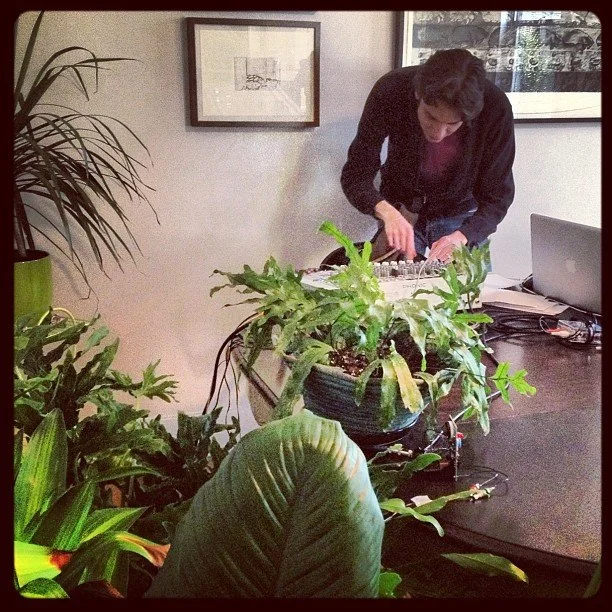
A photo I took of Sam moments before we heard the first notes from a plant.
It happened in Sam Cusumano’s dining room. We were testing the system: Sam had his makeshift sensor built from a Radio Shack lie detector hooked up to a plant, feeding data into my computer where Ableton Live was waiting. Suddenly, the audio meters lit up, and a sound emerged—harmonious, beautiful, and surprising.
I turned to Sam and asked, "Is that the plant?"
"It’s on!" he said.
Immediately, I felt a rush of excitement. And in that exact second, the plant’s signal spiked massively. The system interpreted that spike by turning a reverb knob all the way up, washing the room in a huge, ethereal sound. It felt like the plant was highlighting my own excitement back to me.
I looked at Sam, stunned. "Did that just happen?"
He pointed at the graph on his screen, right at the spike. "It’s in the data".
That was the first time I realized this wasn't just a one-way broadcast. It was a conversation.
“Think Light”
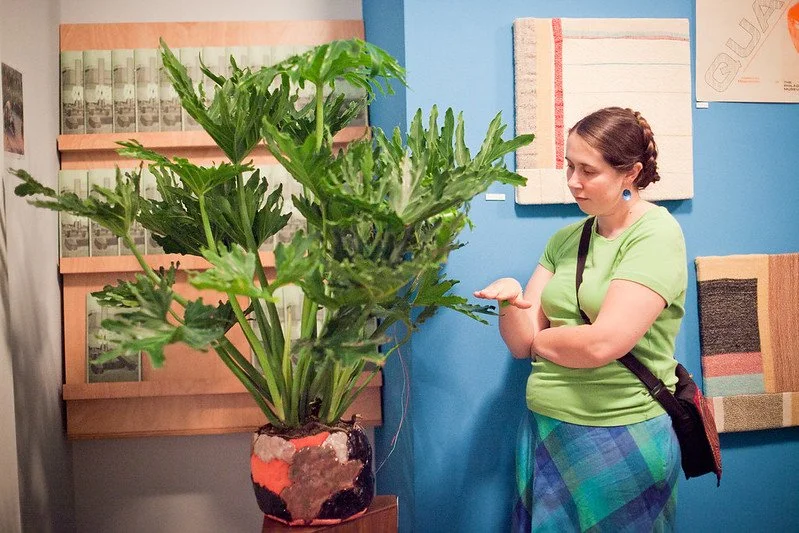
This was a common gesture we’d see from guests at our installation. Placing the hand near, but not touching the plant and listening to how the sound changed.
A few days later, we installed Data Garden Quartet at the Philadelphia Museum of Art. It was a chaotic time. We were dealing with hand-built hardware, long wires, and computers crashing constantly. But once the system was running, the public’s reaction changed everything.
I watched people interact with the plants, often instinctively holding their hands up to feel the energy exchange. One interaction, however, stopped me in my tracks.
A young girl named Melodie walked up to the installation. She held her hands near the leaves, turned to her mother, and said, "Look, Mom, all you have to do is think light coming through your hands and the plants will sing for you".
Her mother started crying, overwhelmed by seeing her child so inspired and intuitively connected. I stood there perplexed. Where did she get that? She understood, instantly and intuitively, that her internal state and energy were affecting the music.
The Healers and the Implicate Order
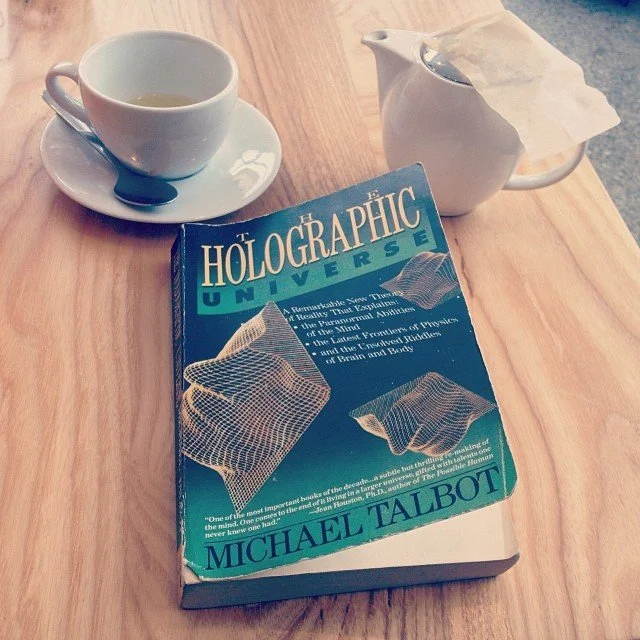
During the lull times at the museum, I sat near the installation reading The Holographic Universe by Michael Talbot, fascinated by the concept of the "implicate order"—the idea that everything we experience is a ripple on a deeper pond of reality.
As I read, I started noticing a pattern. Every once in a while, the music would shift drastically. The monstera plant closest to the entrance, our "lead instrument", would change completely, followed by the others. I would look up and see that someone had just walked into the room. They hadn't touched the plants; they had simply entered the space.
After this happened about four times, I started approaching these people. I’d say, "This might sound crazy, but when you walked into the room, the music completely changed. Did you notice that?".
Instead of looking at me like I was insane, they would nod. "That makes total sense," they’d say. "I’m a Reiki master," or "I’m an energy healer," or "I’m a florist".
The Awakening
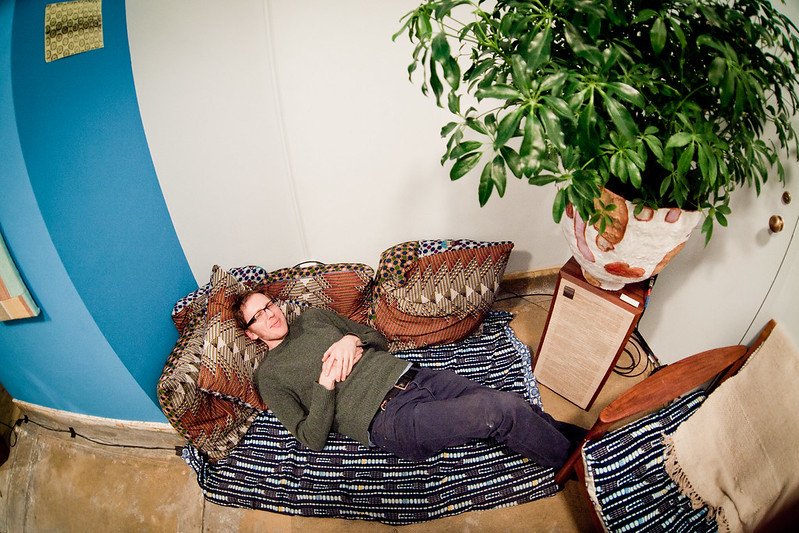
Listening to plant music got me into a state of heightened receptivity and awareness. It felt like an amplifier for my own intuition.
These were people deeply in tune with subtle energy or deeply connected to plants. They confirmed what I was beginning to suspect: plants are incredibly sensitive beings, acting as antennae for energy we can’t always see. Just as they "eat" light to create energy, they seemed to be processing the energy humans carry – that "bright light" you feel when certain people walk into a room.
This was my philosophical awakening. The plants introduced me to the healers, and the healers introduced me to the practices that allowed me to cultivate my own sensitivity, like breathwork and meditation.
I realized then that Data Garden wasn't just about making cool sounds or reducing plastic waste. It was about using technology to extend human perception into subtle realms of reality. I had found the work I was meant to do: to become a channel for bringing this connection to the world.